

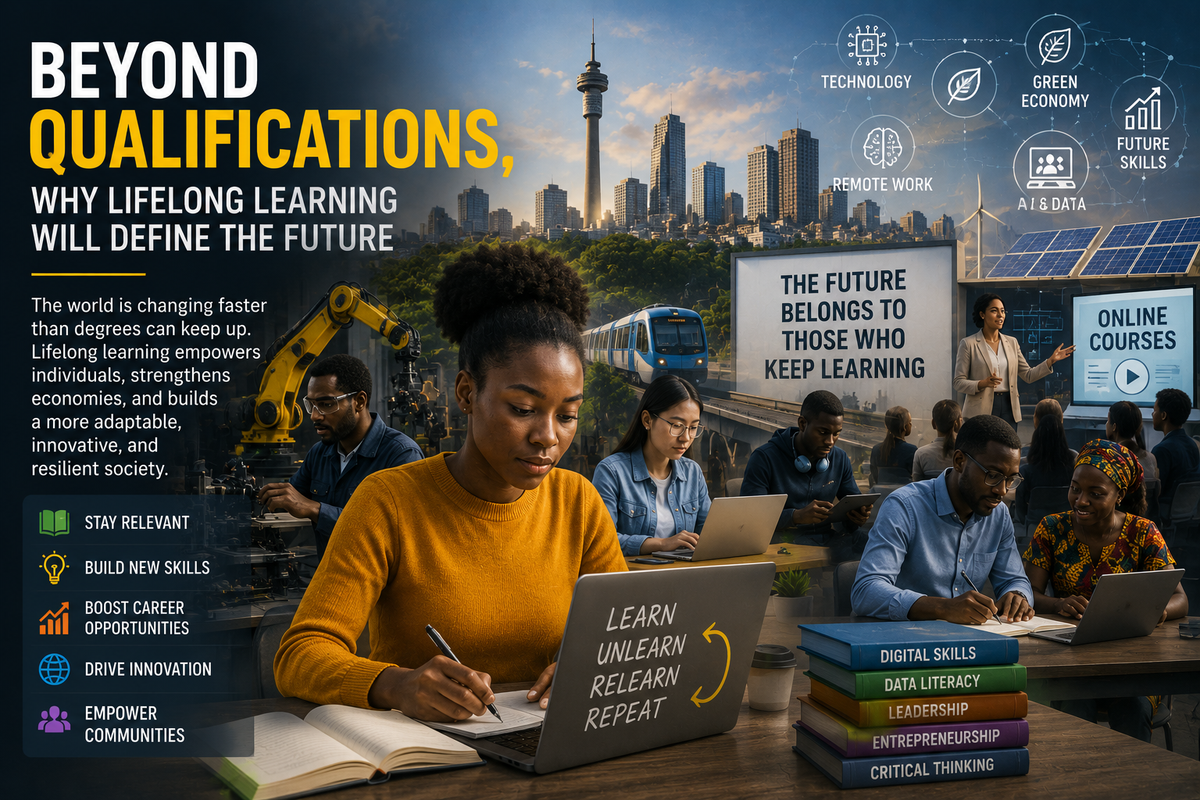
For generations, education followed a familiar pattern: study, graduate, find employment, and build a career based largely on accumulated experience. That model is increasingly under pressure.
Technological change, automation, artificial intelligence, and shifting economic demands are transforming what it means to remain relevant in the workforce. Skills that were valuable a decade ago may no longer be sufficient today. In this environment, learning can no longer be viewed as a phase of life. It has become a continuous process.
The concept of lifelong learning is not new. What has changed is its urgency.
Workers across industries are being required to adapt more rapidly than before. Software developers learn new frameworks. Healthcare professionals update practices in response to emerging research. Educators integrate digital tools. Even traditional sectors such as agriculture and manufacturing are evolving through technology.
The implication is clear: adaptability is becoming as valuable as expertise.
For countries such as South Africa, this shift presents both a challenge and an opportunity. The challenge lies in addressing existing inequalities in access to education and digital infrastructure. The opportunity lies in building a workforce capable of responding to changing global conditions.
Learning also extends beyond employability.
A society committed to learning strengthens civic engagement, critical thinking, and resilience. Citizens who continuously acquire knowledge are often better equipped to evaluate information, participate in democratic processes, and respond to uncertainty.
The rise of artificial intelligence further complicates the conversation. If machines increasingly perform routine tasks, uniquely human capabilities such as creativity, ethical reasoning, communication, and interdisciplinary thinking may become more important.
Education systems may therefore need to evolve from emphasising memorisation toward fostering curiosity, problem-solving, and adaptability.
This raises difficult questions.
Are current educational institutions preparing learners for continuous change? Are organisations creating environments where employees are encouraged to develop new capabilities? And perhaps most importantly, are individuals prepared to view learning as a lifelong responsibility rather than a temporary requirement?
The future may belong less to those who know the most and more to those who remain willing to learn.
In an era defined by uncertainty, learning becomes more than personal development. It becomes a strategy for resilience.
Comments