
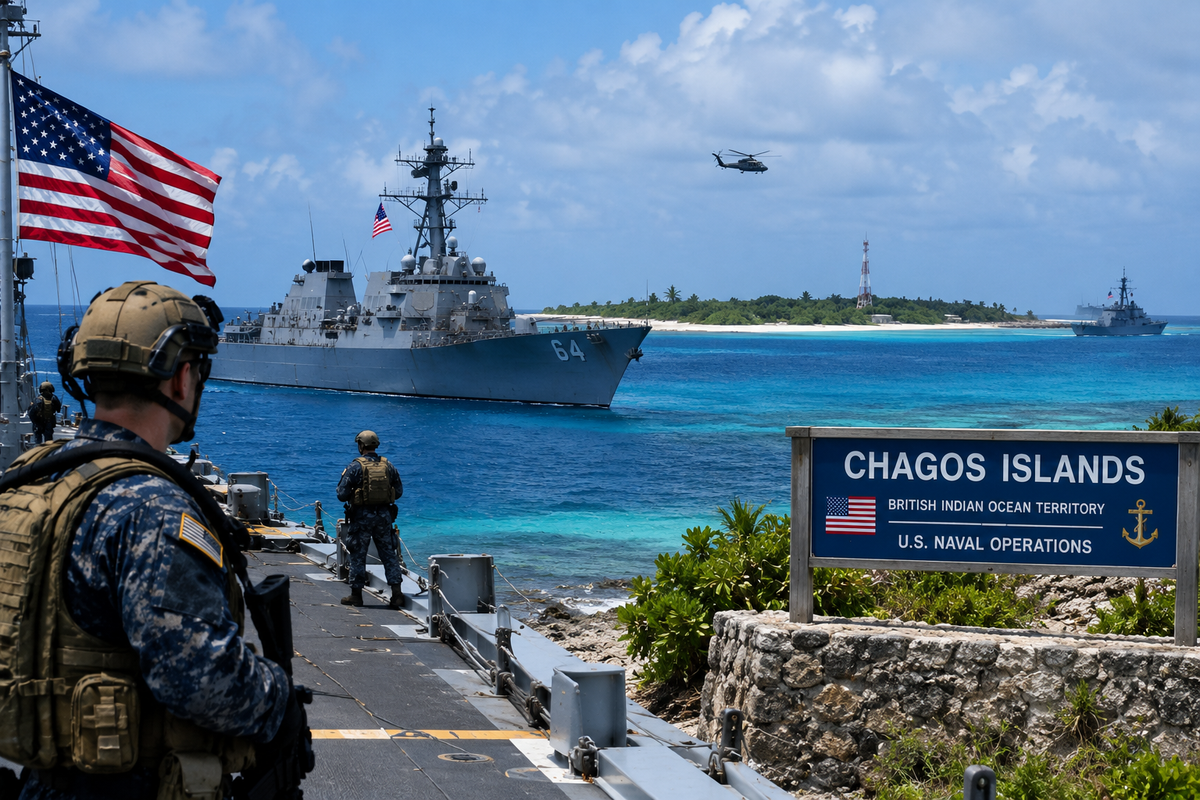
The BIOT is unique in that it is a territory without a permanent population. Prior to the establishment of the BIOT in 1965, a population of former African slaves, then called Ilois and who today call themselves Chagossians, had lived on the territory for just less than 200 years before they were deported to Mauritius and the Seychelles to make way for the US military base.
This paper asserts that the Chagossians are a ‘people’ of the Chagos Islands who are entitled to the right to self-determination in the context of political decolonization. The right of peoples to self-determination has traditionally been applied to people under colonial rule. UN practice defines colonies as overseas, territorial and political entities under colonialism. Self-determination is a collective right of ‘peoples’ as distinct to group rights applicable to minorities. The political right of peoples to self-determination in the context of decolonization is stronger than the right of indigenous peoples to self-determination within independent states, which is limited to autonomy and self-government within an independent State.
There are several cases involving displacement of populations of non-self-governing territories for the military or political objectives of the United States. They include Thule in Greenland, Okinawa in Japan, Vieques and Culebra in Puerto Rico, Hawaii, the Philippines, Panama, Guam and the different atolls in the Marshall Islands. [1]
The question arises whether people of territories like the Chagos Islands, Gibraltar and Falklands Islands (Malvinas) qualify for the right to self-determination. The three territories were acquired through treaties of cession and not through conquest. Does the absence of a permanent population in the Chagos Islands mean that the territory is not a non-self-governing territory? Gibraltar and the Falklands Islands (Malvinas) have permanent populations that are descendants of British settlers. Spain and Argentina insist that the continued British presence on Gibraltar and the Falkland Islands (Malvinas) violates Spanish and Argentine territorial integrity. Does the right of self-determination inhere in the people and not the territory? If, as judge Dillard famously stated in his dissenting opinion in Western Sahara, that ‘it is not for the territory to determine the destiny of the people but it is for the people to determine the destiny of the territory’; then Chagossians have a right to self-determination even after they have been forcibly removed from their homeland.
The absence of a permanent population in the Chagos Islands should not affect its status as a non-self-governing territory and therefore the right of its people to exercise the right of self-determination. The absence of a permanent population in the BIOT is a result of the forcible removal of the population from the territory in the late 1960s and the early 1970s to make way for the United States military base. It is disingenuous that the United Kingdom would seek to rely on the absence of a permanent population on the territory as a reason for not observing its obligations under the UN Charter since it was responsible for the forcible removal. The forcible removal and population transfer were in violation of Article 73 of the UN Charter and principles of international law that prohibit forcible transfer of populations.
The Chagossians are a ‘people’ of a non-self-governing territory. In accordance with the provision of the 1970 Declaration on Friendly Relations they retain a separate and distinct legal identity from Mauritius and the United Kingdom.[2] While the term ‘people’ is not defined, it is a well-established rule of international law that people under colonial rule are entitled to the right of self-determination. The development of the principle of self-determination and international norms governing human rights have changed the traditionally held view that only sovereign States possess legal rights and duties under international law. The Chagossians’ claim to the right of self-determination is not based on principles other than those applicable to the rights of colonised peoples. The Chagossians are a colonised people living in enforced exile. They have consistently expressed the wish to return to their territory. Apart from political acts like undertaking hunger strikes and picketing in both Mauritius and London, they have tenaciously mounted a legal challenge in both United Kingdom and United States courts claiming both compensation for their forcible removal and the right to return.
The book analyzes the prospects for the Chagossians exercising their right to self-determination. The OAU recognized the Saharawi Arab Democratic Republic (SADR) in the 1980s after the POLISARIO Front unilaterally declared independence from Morocco, following which Morocco left the OAU in protest. The SADR is a founding Member State of the AU while Morocco is not a member. Case studies of self-determination in 3 (three) island communities will be examined as possible models for the exercise of self-determination by the Chagossians. Mayotte is an integrated ‘department’ of its former colonial power, France, while it is geopolitically linked to and is within the Comoros Archipelago. Greenland used to have Home-Rule as a province of Denmark until it gained ‘self-governing’ status in June 2009. East Timor used to be a Portuguese colony; was occupied by Indonesia when Portugal left in 1975; and has obtained independent Statehood in 2002 after a period of direct administrative and judicial control by the United Nations.
SCOPE OF THE STUDY
The Chagos matter raises a number of important questions in international law that, if taken separately, are major areas of study in themselves. The central argument in the current study does not hinge on whether the Chagossians satisfy the ‘definition’ of being an indigenous people of the Chagos Islands, because it asserts that they are a ‘people’ entitled to self-determination in the context of political decolonization.
The sovereignty dispute between Mauritius and the United Kingdom of Great Britain and Northern Ireland over the Chagos Islands; the legality or otherwise of how Mauritius lost sovereignty over the Chagos Islands; and the contention of Mauritius that she be allowed to resume sovereignty over the Chagos Islands (BIOT) is in itself a major area of research, which goes beyond the scope of the current study. It is a matter for a possible future publication by the author.
[1] David Vine, Island of Shame at page 65 provides several examples of displacement of indigenous populations of Hawai’i by the US Navy in 1885 and 50 years later after the Japanese attack on Pearl Harbour. The US military took possession of more than 45 % of the land in Guam in 1944. Panama experienced 19 land expropriations around the Panama Canal Zone between 1908 and 1931. The 1945 Battle of Okinawa led to 20 % of the island’s arable land being seized by the US military. Between 1954 and 1964 about 3218 people from the Okinawa in Japan were resettled in faraway Bolivia in Latin America where there was no resettlement programme and no financial assistance put in place for them. Several have since found their way back to Okinawa. Between 1941 and 1943 and again in 1947 and the US army displaced thousands of people from the small island of Vieques in Puerto Rico. In 1948 the US Navy seized 1700 acres of land in the neighbouring island of Culebra in Puerto Rico. The displacement of the indigenous people of Alaska from their homes to other parts of the island in 1942 has some similarities with the case of the Inughuit people of Thule Denmark. The US Congress granted the surviving islanders from Culebra some compensation after the passing of an Act of Congress in 1988.
[2] Declaration on the Principles of International Law Concerning Friendly Relations and Cooperation Among States in Accordance with the Charter of the United Nations, GA Res. 2625(XXV), 24 October 1970.
Comments