


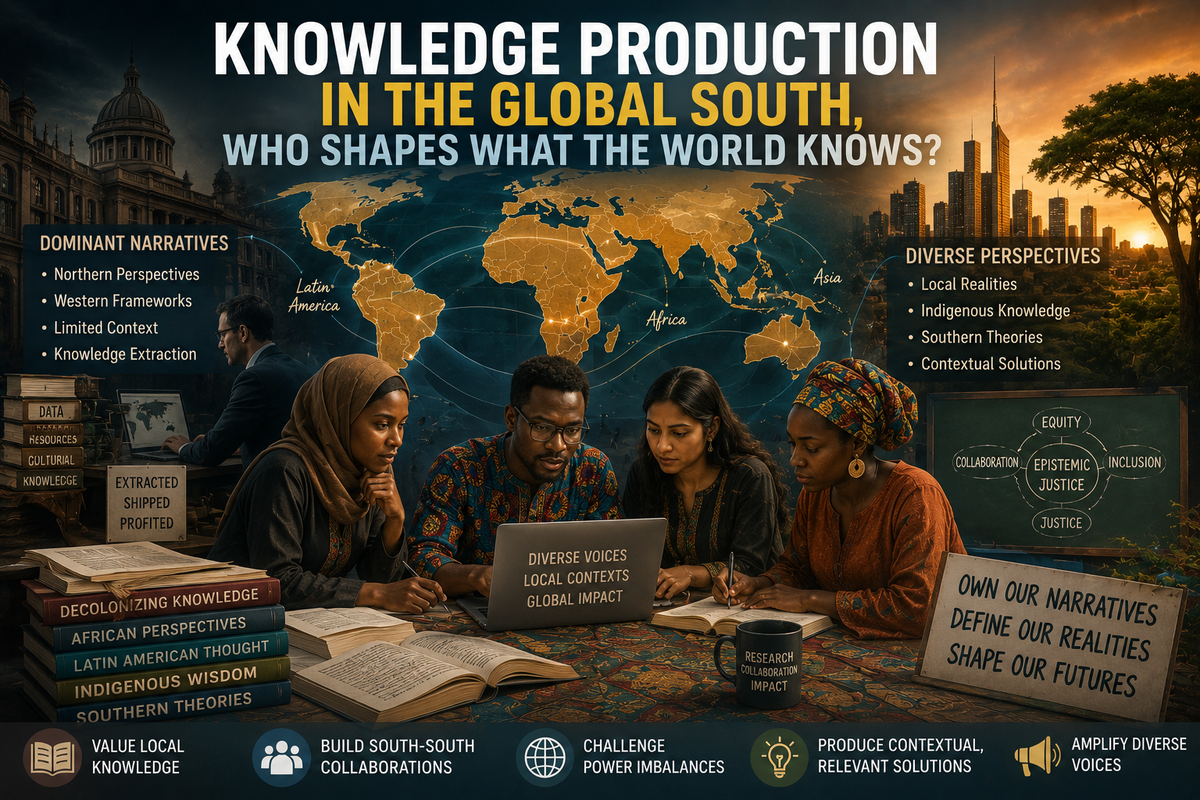
Knowledge is often treated as neutral, objective, and universally accessible. Yet the processes through which knowledge is produced, validated, and distributed are shaped by institutions, funding, geography, and power.
This raises an important question: who determines what becomes accepted knowledge?
Historically, much of the worldÔÇÖs academic and scientific output has originated from institutions in the Global North. Research agendas, publication systems, and citation networks have often reflected priorities established within those contexts.
This does not diminish the quality or importance of such research. However, it highlights a structural imbalance that continues to influence global understanding.
For countries in Africa and other parts of the Global South, the challenge is not merely consuming knowledge produced elsewhere. It is strengthening the capacity to generate contextually relevant knowledge that reflects local realities, priorities, and experiences.
Knowledge production matters because it influences policy.
Research shapes public health responses, educational models, agricultural practices, economic strategies, and technological innovation. When knowledge systems overlook regional contexts, solutions may fail to address local challenges effectively.
Universities therefore play a role extending beyond teaching. They are sites of knowledge creation.
The question facing many higher education institutions is whether they are sufficiently supported to fulfil this function. Funding constraints, unequal access to research infrastructure, and barriers within global publication systems continue to affect research output in many developing contexts.
At the same time, digital technologies are changing the landscape.
Artificial intelligence, open-access publishing, collaborative platforms, and distributed research networks are lowering some barriers to participation. Scholars increasingly have opportunities to contribute to global conversations without relying exclusively on traditional pathways.
Yet accessibility alone does not guarantee influence.
Building robust knowledge ecosystems requires investment in:
- Research infrastructure
- Interdisciplinary collaboration
- Academic freedom
- Open data initiatives
- Support for early-career researchers
Knowledge production is also closely connected to sovereignty.
Countries that generate their own research capabilities may be better positioned to make independent decisions, respond to emerging challenges, and innovate according to domestic priorities.
The conversation extends beyond universities.
Industry, government, civil society, and communities all contribute to knowledge creation. Practical experience, indigenous knowledge systems, and local innovation can offer valuable insights alongside formal academic research.
Perhaps the most significant question is not whether knowledge is being produced, but whose perspectives are represented within global systems of understanding.
As the world becomes increasingly interconnected, diversity in knowledge production may become essential rather than optional.
The future of innovation may depend not only on generating more knowledge, but on broadening who gets to create it.
Comments